Modern Staples Every New Player Should Own (And Why They're Worth It)
June 30, 2026 · 9 min read
You crack open your first Modern decklist, scroll to the bottom, and your stomach drops. The total looks like a car payment. Welcome to one of Magic's deepest, most rewarding formats — and also one of its most intimidating to enter.
Here's the good news: you don't need to buy a deck all at once. The smartest way into Modern is to acquire format staples — cards that show up in dozens of different decks, hold their value, and never rot in a binder. Buy these first, and every future deck you build gets cheaper because you already own the expensive shared pieces.
Let's talk about what actually belongs at the top of that shopping list.
Why "staples" beat "a netdeck"
A netdeck is a snapshot of one meta on one weekend. Staples are the bedrock that survives bannings, rotations of the unofficial metagame, and your own changing taste. If you buy a Cavern of Souls today, it will be just as good in a tribal deck three years from now as it is in your current one.
Buy Cavern of Souls on TCGplayer →
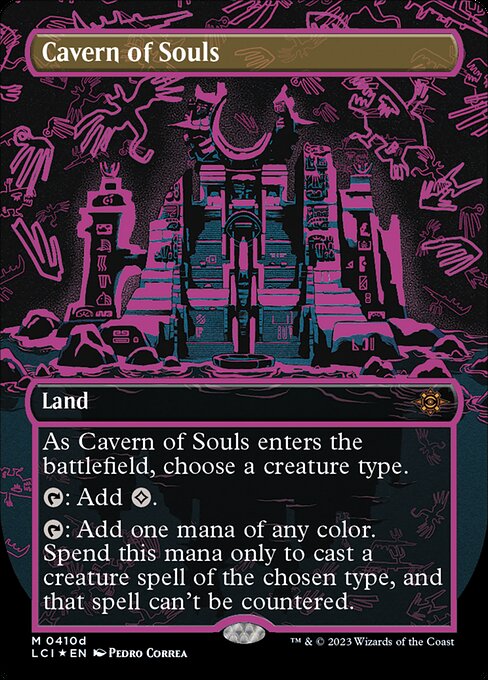
Cavern of Souls is the poster child for this idea. It's a land that fixes mana for any creature type and makes that creature impossible to counter. Merfolk, Humans, Goblins, Slivers, any creature-tribal deck wants it. It's expensive — currently sitting near the top of the value charts at around $4,900 for the original printings — but it has been reprinted, and even the cheaper printings do the exact same job. The point is that it's a card you buy once and slot into deck after deck. That's the staple mindset: spend on flexibility, not on a single 75.
Mana fixing first, always
If you take one lesson from this article, make it this: buy your lands and mana before your spells. Spells change with the meta. Good mana is forever.
Fetchlands and shocklands
In Modern, the dual-land engine that makes multicolor decks hum is the fetchland-plus-shockland package. Fetchlands like Scalding Tarn, Misty Rainforest, Verdant Catacombs, and Polluted Delta thin your deck, fix your colors, and enable cards that care about graveyards and landfall. Pair them with shocklands like Steam Vents, Watery Grave, and Sacred Foundry and you have a mana base that supports basically any two- or three-color strategy.
These aren't the flashiest cards you'll own, and they're not the most expensive things on the value charts, but they are the single best investment a new Modern player can make. A fetch/shock base is a sunk cost you'll reuse forever. Buy duals before you buy bombs.
Utility lands that win games
Beyond fixing, certain lands do real work. Cavern of Souls we covered. Boseiju, Who Endures is a land that's also a flexible answer to artifacts, enchantments, and problem lands — and it comes back from the graveyard via its channel ability. Urza's Saga is a land that becomes a creature factory and tutors up cheap artifacts. These are the lands that quietly decide games, and they slot into a huge range of decks.
The cheap interaction that defines the format
Modern is a format where games are decided by efficient interaction. You want a small toolbox of premium answers that you can run in almost any deck with the right colors.
Lightning Bolt
There is no more iconic Modern card than three damage for one mana.

Buy Lightning Bolt on TCGplayer →
Lightning Bolt kills early creatures, burns out planeswalkers, and ends games by going face. It has been a defining card since the dawn of the format. If you play red at all, you want a playset, and it's blessedly affordable thanks to dozens of reprints. This is the kind of card that proves Modern isn't all four-figure price tags — some of the most powerful staples cost a few dollars.
While we're on cheap red staples, grab Lightning Helix for lifegain-plus-burn in Boros decks, and consider Unholy Heat, which deals a whopping six damage with delirium for a single mana. Delirium is easy to enable in a fetchland deck, which is another reason your land base comes first.
Premium removal and counters
In black, Fatal Push is the gold standard for one-mana removal, killing most of the format's threats outright. In white, Prismatic Ending and Swords to Plowshares (for Eternal-adjacent builds) handle a wide swath of problems. In blue, Counterspell and the flexible Force of Negation keep combo and control decks honest.
None of these is a budget-buster, and all of them appear across many decks. Owning a playset of the format's best removal means you can pivot archetypes without re-buying your answers every time.
Cards that go in everything
Some staples transcend color identity and archetype. These are the cards you'll find yourself reaching for no matter what you're building.
Birds of Paradise

Buy Birds of Paradise on TCGplayer →
Birds of Paradise is one of the oldest and most elegant cards in the game: a one-mana flyer that taps for any color. It accelerates you a full turn ahead and fixes your colors at the same time. It commands a premium — premium printings sit near $3,960 — but the function is what matters, and you can find affordable copies. Green ramp and creature decks have wanted this bird for decades, and it remains a staple in everything from Amulet ramp to creature combo. If you play green, this is a foundational acquisition.
In the same vein, Noble Hierarch offers similar acceleration plus an Exalted boost, and is a mainstay of aggressive creature decks. Mana creatures are like fetchlands: boring on the surface, format-warping in practice.
Ragavan, Nimble Pilgrim... er, Nimble Pilgrim
Ragavan, Nimble Pilgrim (better known by its full name, Nimble Pilgrim — the famous monkey) is a one-drop that generates Treasure and exiles cards off the top of your opponent's library. It's one of the most powerful aggressive creatures in Modern and a chase card in its own right. If you intend to play any red tempo or aggro deck, it's worth saving up for.
Graveyard and recursion engines
Modern has a healthy graveyard subtheme, and a few cards anchor it.
Tarmogoyf was the original "big body for cheap" creature, scaling with card types in graveyards. While it's not the format-warper it once was, it's a piece of Modern history and still seeing play in fair midrange shells. More relevant today, Grief and the Evoke-elemental package have reshaped how black decks attack the hand, while Murktide Regent gives delve decks a giant flyer that exiles instants and sorceries to grow.
The lesson again: these cards reward you for the fetchlands you bought first. A well-stocked graveyard is free value, and your mana base is the engine that fills it.
A word on the truly expensive stuff
Let's be honest about the cards at the very top of the value charts. You'll notice that pieces like Tundra and Badlands — original dual lands — command around $4,100 and $2,500 respectively, but those are not Modern-legal. The original duals belong to Legacy and Vintage. Same story with the Power Nine: Black Lotus, Time Walk, Timetwister, the Moxen — those are gorgeous, iconic, and completely outside the Modern card pool.
Sol Ring, which sits around $3,000 for early printings, is a Commander superstar but also banned in Modern. I bring these up not to tease you, but to save you from a common new-player mistake: don't buy a famous expensive card assuming it's legal in your format. Always check legality before you spend. The most expensive card on a price list is rarely the one you need for Modern.
The genuinely format-defining Modern lands and creatures — your Caverns, your fetchlands, your Birds — are the ones worth the splurge, because they're legal and reusable.
A practical buying order for new players
Here's how I'd stage purchases if you're starting from zero and want to maximize what each dollar unlocks:
- Fetchlands and shocklands in your colors. The reusable foundation. Buy the two or three you'll use most before anything else.
- Premium one-mana interaction. Lightning Bolt, Fatal Push, Prismatic Ending — cheap, ubiquitous, and never dead weight.
- Mana creatures if you're green. Birds of Paradise and Noble Hierarch pay for themselves in tempo.
- Color-defining utility lands. Cavern of Souls, Urza's Saga, Boseiju, Who Endures — pick the ones your archetype wants.
- The signature threats of your chosen deck. This is where you finally buy the Ragavan, Nimble Pilgrim or Murktide Regent that makes your deck your deck.
Notice the expensive flashy threats come last. By the time you buy them, you've already assembled a mana base and interaction suite that supports half a dozen possible decks.
Buy quality, buy condition, buy once
A few habits that'll save you money over a Modern career:
- Prefer the cheapest legal printing. A card's function doesn't change with the art. A budget-printing fetchland fixes mana exactly like the bordered showcase version.
- Buy played condition for staples you'll sleeve forever. Lightly played fetchlands live in a sleeve their whole life. Save the premium for cards you actually want pristine.
- Don't chase the meta with singles. When a new set drops — and the release calendar has been busy, with sets like Star Trek and Reality Fracture arriving recently — wait a few weeks for hype prices to settle before buying the new hotness.
- Trade into reusable cards. If you're offloading a deck, roll the value into fetchlands and Caverns rather than a single deck's worth of niche spells.
The takeaway
Modern's reputation as an expensive format is half-true. Yes, a tier deck has a real price tag. But the format rewards patient, smart buyers more than almost any other. Spend on the shared infrastructure first — your fetchlands, your shocklands, your Cavern of Souls, your Birds of Paradise, your playset of Lightning Bolt — and you'll find that every subsequent deck costs a fraction of its list price because you already own the bones.
Buy mana before spells, buy legality-checked staples before chase cards, and buy things you'll use across multiple decks. Do that, and Modern stops feeling like a money pit and starts feeling like a collection that pays you back game after game.