The Beautiful Mistakes: Magic's Most Valuable Misprints and Printing Errors
June 30, 2026 · 10 min read
A printing press that hiccuped in the late 1990s might be sitting in your binder right now, quietly worth more than a sealed booster box. Magic: The Gathering has spawned one of the strangest collecting subcultures on the planet — people who chase the cards Wizards of the Coast got wrong. Miscuts, misprints, crimps, square-cut corners, gold-bordered foils that shouldn't exist. The mistakes.
Unlike a graded Power Nine card where the value is well-documented and stable, error cards live in a wilder market. They're one-of-a-kind by definition, prices swing on collector obsession, and provenance matters enormously. But the appeal is obvious: you can't strategize your way into owning one. You either stumble onto it or you pay up. Let's walk through the kinds of errors that turn a common card into a trophy — and the high-value cards that become legends when they go wrong.
What Counts as a Misprint
Not every weird card is valuable. Wear, water damage, and intentional alterations don't count. A true collectible misprint is a factory error — something that happened at the printing or cutting stage and slipped through quality control. The main categories:
- Miscuts — the cutting blade lands in the wrong spot, so you see part of a neighboring card.
- Crimps — a card gets pinched by the machine that seals booster packs, leaving a permanent dented line.
- Off-center / square cuts — the sheet was cut with no rounded corners or wildly off-register.
- Color errors — a missing ink layer, a color shift, or a swapped tone.
- Print-line and ink errors — streaks, double prints, ghosting.
- Foiling errors — foil where it shouldn't be, or missing foil entirely.
The golden rule of error collecting: rarity of the card plus severity of the error equals value. A dramatic miscut on a bulk common is a fun curiosity. A dramatic miscut on a dual land or a piece of Power is a grail.
The Power Nine Effect
The single biggest driver of misprint value is the underlying card. When the base card is already a four-figure staple, any factory error stacks a collector premium on top of an already-steep price.
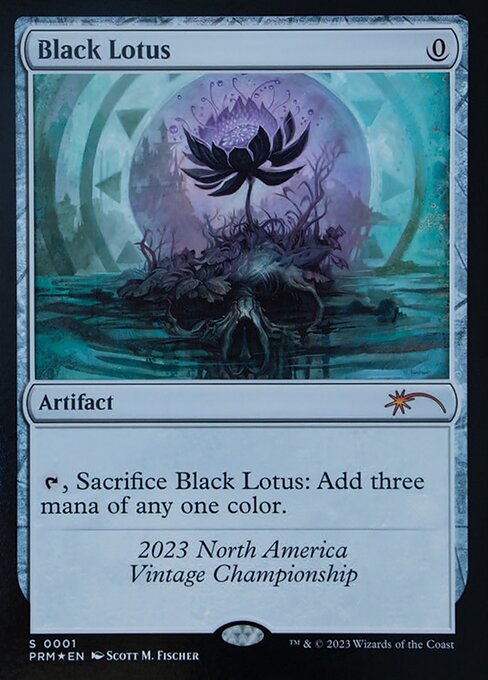
Consider Black Lotus. The most famous card in the game is valuable in any condition, but a genuine miscut or off-register Lotus from Alpha or Beta is the kind of object that doesn't really have a "price" so much as a negotiation. Even a clean copy sits at a serious number — our latest data has a Black Lotus listed around $3,299.99 — and that's the baseline before you factor in a printing anomaly.
Buy Black Lotus on TCGplayer →
The same logic applies across the original Moxen. A standard Mox Emerald already commands roughly $4,453, Mox Jet sits near $4,000, Mox Pearl around $3,200, and Mox Sapphire and Mox Ruby track similarly. These tiny artifact gems are notorious among error hunters because their small art windows make miscuts and off-centering visually striking. A Mox where the picture frame is shifted halfway off the card is the kind of thing that gets photographed and passed around collector forums for years.
The Most Famous Misprint of All: The Hurloon Minotaur Frame Error
If you've spent any time in the misprint world, you know the story of the upside-down and mismatched art frames from the game's earliest days. Old Magic sheets occasionally had picture boxes that didn't line up with the text — but the real legend involves cards printed with the wrong picture frame entirely, or art rotated within the box.
These early production-era oddities matter because Alpha and Beta were genuinely experimental print runs. Wizards was figuring out the manufacturing process in real time, which is exactly why so many beloved errors trace back to 1993–1994. The corner-rounding on Alpha cards was famously inconsistent, leading to the well-known Alpha "rounded corner" look that distinguishes the print run — not technically a misprint, but a manufacturing fingerprint that collectors prize.
Crimps: The Pack-Sealing Scars
A crimp happens at the very end of the process, when the machine that seals booster packs pinches a card poking out of place. The result is a clean, straight indentation running across the card. To a player, it's a damaged card. To an error collector, a crimp on the right card is gold.
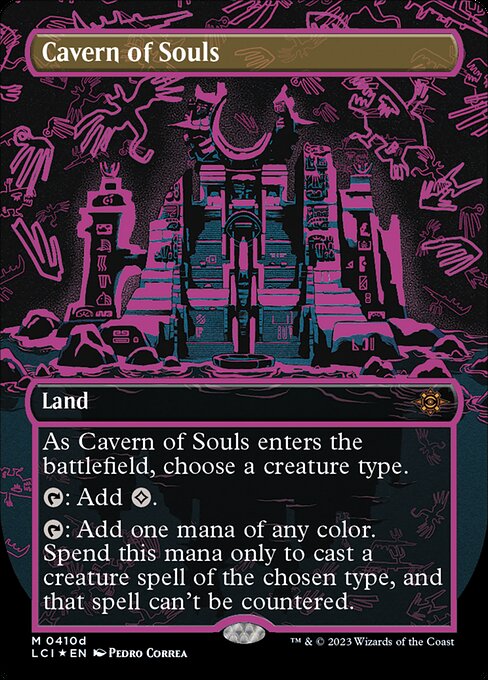
Why? Because a crimp is proof the card came straight from a sealed pack — it can't be faked easily, and it ties the card to a specific product. Crimped foils from chase-heavy sets are especially sought after. A crimp on a $20 card is a novelty; a crimp on a card like Cavern of Souls — which sits around $4,900 for premium versions in our data — turns a hyper-playable staple into a museum piece. The card is in nearly every tribal deck ever built, so a factory-error copy carries both collector cachet and a nod to its competitive pedigree.
Buy Cavern of Souls on TCGplayer →
Color and Ink Errors on Dual Lands
The original ABUR dual lands are some of the most collected cards in all of Magic, and their understated art makes ink and color errors pop. A Tundra (around $4,100) or Badlands (around $2,499.99) with a missing color layer or a dramatic color shift becomes immediately recognizable.
The most coveted dual-land errors involve register problems where the color separations don't align — you'll see a slight "3D glasses" ghosting effect, or text and borders that drift. Because duals are so heavily traded and graded, the community has documented many of these anomalies, which actually helps value: a known, cataloged error has provenance that a random oddity lacks.
Badlands in particular is a fun target because its mountainous, rusty art makes any tonal shift obvious to the naked eye — a green-tinted or washed-out Badlands jumps out instantly.
Reserved List Heavyweights Make Wild Error Cards
The Reserved List — Wizards' promise never to reprint certain cards — guarantees that any error on those cards is locked in forever. There will never be a corrected reprint to dilute the pool. That permanence drives the high end of misprint collecting.
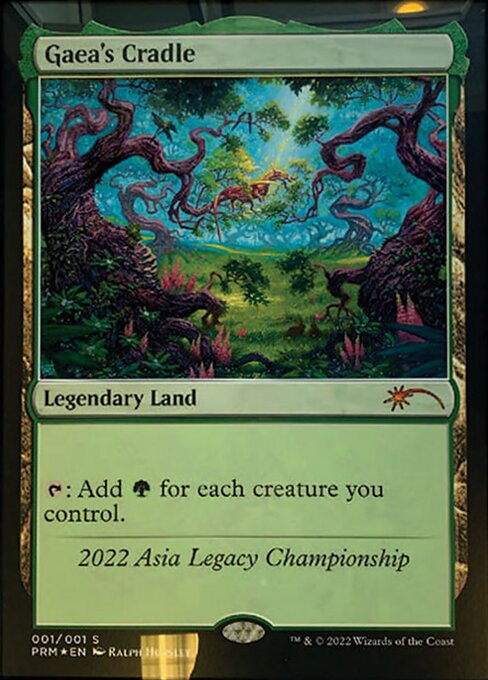
Look at the heavy hitters from the old days. Gaea's Cradle sits around $3,999, Mishra's Workshop near $3,001, The Tabernacle at Pendrell Vale around $2,899.99, and Grim Monolith near $3,498. These are already expensive, Reserved-List-protected cards. A genuine factory miscut on any of them is essentially a unique artifact — there's a finite supply of the card and an even tinier supply of error copies.
Buy Gaea's Cradle on TCGplayer →
Gaea's Cradle is a perfect example of the dynamic: it's an iconic, format-defining land with gorgeous art, it's on the Reserved List, and its sweeping landscape makes any cut error or color problem visually dramatic. Combine all three factors and you have the ideal misprint candidate — desirable, scarce, and impossible to reprint a clean version of.
Foiling Errors: When the Shine Goes Wrong
Foil technology introduced a whole new category of mistakes. The most prized:
- Missing foil — a card from a foil sheet that didn't receive its foil layer, leaving it strangely flat where it should shimmer.
- Reverse holo — the foiling appears on the wrong side or in the wrong pattern.
- Foil bleed — the foil layer extends past where it should.
Foil errors became more common as Wizards experimented with new finishes, and the modern era's premium treatments — etched foils, textured foils, surge foils — each introduced fresh ways for the process to go sideways. Cards like the double-faced Elesh Norn // The Argent Etchings (around $3,999.99) come in elaborate premium versions where any foiling inconsistency is immediately noticeable and hotly debated among collectors trying to determine whether it's an intentional treatment or a true error.
The Modern Twist: Universes Beyond and Booster Fun
Misprint collecting used to be an Old-School-only hobby, but the explosion of premium treatments has changed that. Today's high-value chase cards often come from crossover sets and serialized print runs, and errors on those carry real weight because the cards themselves are so coveted.
Look at how the market values modern crossover chase cards: Tamiyo, Inquisitive Student // Tamiyo, Seasoned Scholar tops our list near $6,550 thanks to its serialized and special treatments, and Final Fantasy crossover cards like Tifa Lockhart (around $4,531) and Aerith Gainsborough (around $3,600) command big numbers. When a card is already this expensive and chase-worthy, a factory miscut or foiling error transforms a $4,000 card into a true one-of-one conversation piece.
The newest sets keep the pipeline flowing. Releases like Star Trek and Star Trek Commander, The Hobbit, Marvel Super Heroes, and Reality Fracture all use the modern premium-treatment playbook, which means the next legendary misprint is probably being pulled from a pack as you read this. Set foil sheets, serialized stamping, and textured finishes give error hunters more surface area than ever.
How to Tell a Real Misprint From a Fake
Because error cards can be valuable, the market attracts fraud. A few defensive principles:
Factory errors leave consistent fingerprints
A real miscut shows the same printing alignment across the whole card — the error is uniform with the sheet it came from. An altered or trimmed card shows inconsistencies under magnification.
Crimps run dead straight
A genuine pack-seal crimp is a clean, machine-pressed line. A bent or creased card has irregular, organic damage. Learn the difference before you pay a premium.
Color errors should affect the whole card
A missing ink layer affects every element printed in that color, not just one spot. A single discolored patch is more likely damage or alteration.
Provenance is everything
The most valuable error cards have documented histories — known forum threads, prior sales, photos over time. A card pulled fresh from a sealed pack on camera carries enormous credibility. For high-dollar errors, grading by a reputable company that authenticates the anomaly is worth every penny.
Should You Actually Collect Misprints?
If you love the story of Magic — the human, mechanical, fallible process behind those cardboard rectangles — misprints are the most charming corner of the hobby. They're conversation starters, they're genuinely scarce, and the best ones are unrepeatable.
But go in clear-eyed:
- Liquidity is low. There's no published price for a unique error. You sell when you find the right buyer, not when you want to.
- The base card carries the floor. A misprint on a bulk common will always be a novelty. If you want value, target errors on cards that already command money — Power, duals, Reserved List staples, and modern chase crossovers.
- Condition still matters, but error collectors weigh it differently than standard buyers. A heavily played card with a spectacular miscut can outvalue a near-mint clean copy.
The smart play for most collectors: keep an eye out, learn to recognize the real thing, and grab affordable errors on cards you already love. If you ever pull a crimped or miscut version of something like Sol Ring (around $3,000 for premium copies) or a beloved dual land, you've got something special — even if you never sell it.
The Takeaway
Magic's most valuable misprints prove a delightful truth: rarity isn't always designed, sometimes it's an accident. The cards that command the biggest error premiums are the ones that were already special — Power Nine, ABUR duals, Reserved List icons, and today's blockbuster crossover chases — because a factory mistake stacks irreplaceable scarcity on top of proven demand. Learn the categories, respect provenance, and remember that the best misprint is the one that tells a story. Sometimes the printer's worst day is a collector's best find.